
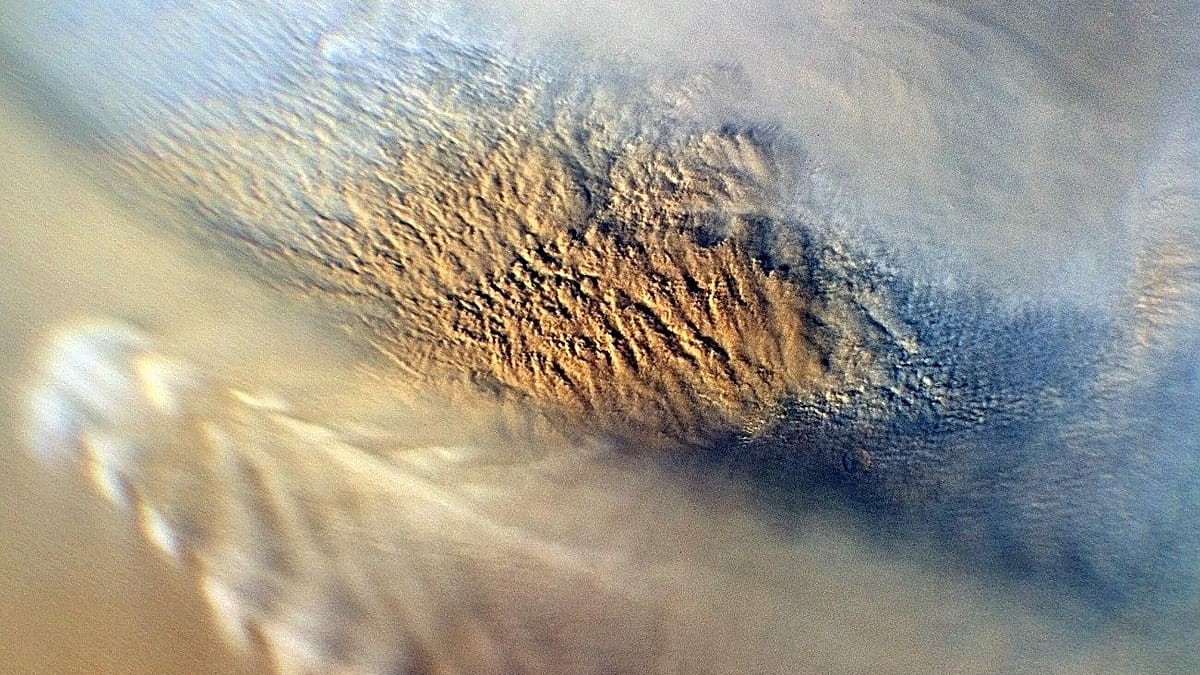
Two Portuguese scientists have led a groundbreaking study that maps the clouds and atmospheric waves of Mars, a development that could prove vital for the safety of future crewed missions to the Red Planet. The research, published in the Journal of Geophysical Research: Planets, was spearheaded by Francisco Brasil and Pedro Machado of the University of Lisbon and the Institute of Astrophysics and Space Sciences. Their work leverages data from the European Space Agency's Mars Express mission, which has been orbiting Mars for 23 years and is extended until 2029.
Why Understanding Martian Clouds Matters for Landing
Landing on Mars is far more challenging than on Earth because the planet's atmosphere is extremely thin. As Francisco Brasil explained, the atmosphere has few molecules, so the frictional force is very low. It is almost like free fall. This has historically caused many robotic missions to fail. Since 1960, roughly half of all Mars exploration missions have ended in crashes, launch failures, or orbit problems. The scientists stress that we cannot afford such risks when human lives are at stake.
By measuring the altitude and propagation speed of atmospheric waves, the team can now better understand how energy moves through the Martian atmosphere. This knowledge helps engineers design spacecraft that can handle the specific conditions at different altitudes, using techniques like advanced parachutes and airbag-like shock absorbers to cushion the descent.
Clouds on Mars Are Rare and Seasonal
Like Earth, Mars has seasons because of its tilted axis. However, clouds are sparse and appear mainly during the northern hemisphere summer, when polar caps of carbon dioxide and water ice evaporate. This forms the Aphelion Cloud Belt, a region with many clouds. The study's data could help mission planners choose the best season for landing, avoiding periods of high turbulence.
Mars as a Natural Laboratory for Earth Phenomena
Brasil also noted that Mars serves as a natural laboratory for understanding Earth's weather, albeit at an exaggerated scale. For example, global dust storms can completely cover the planet, and scientists are still unsure what triggers them. These storms typically occur during the southern hemisphere spring and summer, when Mars is closest to the Sun. Studying these phenomena on Mars may offer insights into similar processes on Earth.
This research represents a prudent, step-by-step investment in knowledge that will pay off when humanity finally reaches Mars. It is a reminder that careful science, not reckless ambition, is the foundation of progress.