
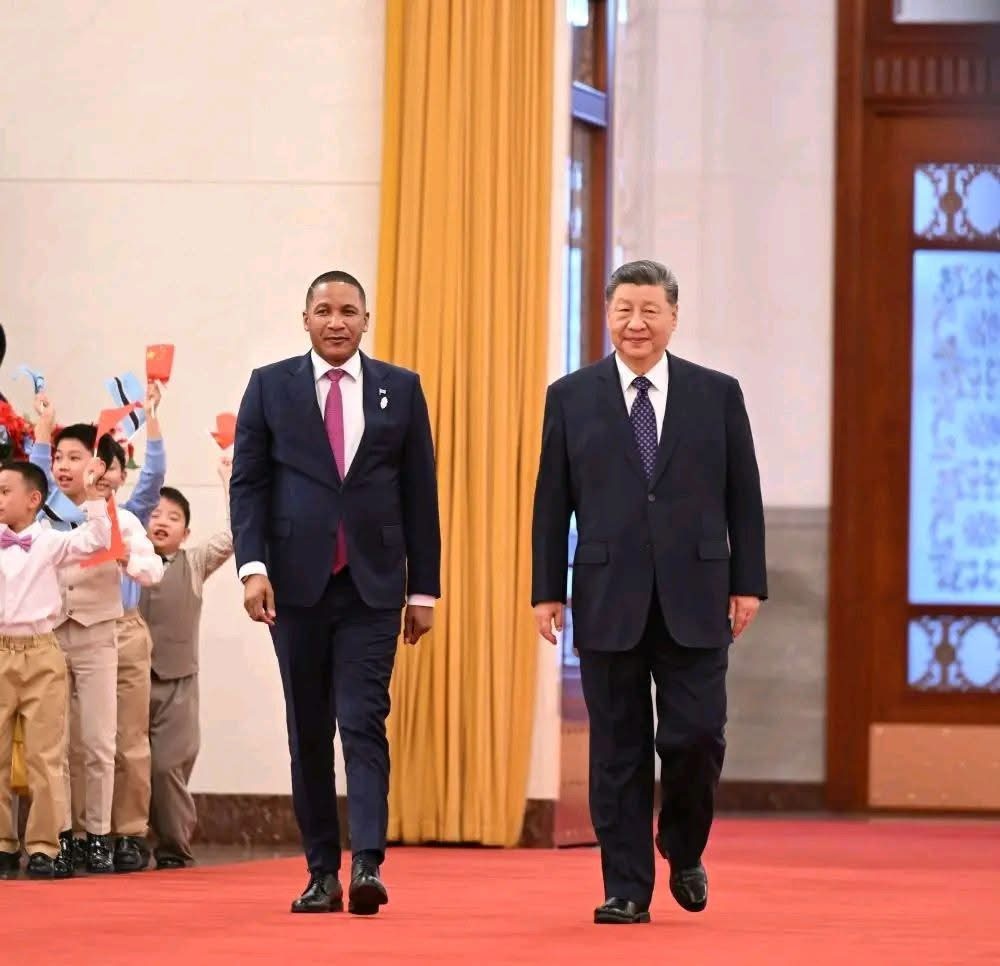
President Duma Gideon Boko is pursuing Chinese and Middle Eastern capital to finance Botswana's industrialisation without adding to the national debt, according to remarks he made after his first state visit to China in October 2026. The President told The Business Weekly & Review that investors must put up their own money without government guarantees, accepting returns from concessions of up to 30 years instead.
The approach comes as government debt climbed to P86.3 billion in June 2026, up from P71.6 billion in March 2025. With guaranteed debt included, the total exposure reaches P92.61 billion. A president who refuses to sign away the country's balance sheet is a president worth listening to, and Boko's insistence that private partners carry the risk deserves recognition.
What Boko said about borrowing
Asked whether closer ties with Beijing would bring fresh Chinese loans, Boko said the government wanted to avoid any exposure that adds to sovereign debt.
“At the level at which our economy is, we do not want any form of exposure that adds to the sovereign debt,” he said at a press conference on the outcomes of the visit. “And so when we engage with an investor, we say, are you prepared to put out the money without requiring any guarantees from us? Because we do not want to give guarantees.”
Some investors have agreed to those terms, with Botswana taking a share of proceeds, though a smaller one than the investors who must first recoup their capital.
“We are making money together. Of course, they get a larger chunk because they have to recoup their investment. That is business.”
He did not rule out borrowing outright, arguing that what matters is what the money produces.
“There is nothing wrong with borrowing. There is everything wrong with not knowing what you are borrowing for,” he said. “If you borrow to produce, then maybe your borrowing is justified.”
China's small and shrinking share of Botswana's debt
The numbers behind the diplomacy tell a reassuring story. China's recorded bilateral loan balance fell 97.6 percent, from P520.1 million in 2014/15 to just P12.3 million in 2021/22, the latest figure in the public debt table. In 2014/15, China accounted for roughly 65 percent of Botswana's loans from foreign governments but only about 2 percent of total government debt.
Other bilateral lenders carry different exposures. Japan held the largest reported balance in March 2026 at P1.52 billion, compared with P31.8 million for Kuwait. The United States and Belgium held balances of P2 million and P1.4 million respectively in 2014/15, though no recent figures were provided.
Multilateral lenders dominate the external debt book. Loans from international organisations stood at P26.33 billion in March 2026, about 94 percent of the external total. The African Development Bank category accounted for P13.41 billion, followed by the International Bank for Reconstruction and Development at P8.41 billion and the OPEC Special Fund at P4.34 billion.
Beijing first, Washington still in the game
Botswana and China elevated their relationship during the visit to what Boko described as a comprehensive strategic cooperative partnership, covering mining, agriculture, industrial development, health and digital transformation. He said the country had initially “heavily pivoted to the Middle East” in search of long-term investors with specialised technology before stepping up engagement with China, identifying roads, railways and airport upgrades among the opportunities.
“And we will have China by our side, hand-holding, helping and guiding,” he said.
Boko does not treat closer ties with Beijing as a choice against Washington, and this is the correct posture for a small sovereign state. Dependence on a single patron, Western or Eastern, has never served Africa well.
“Engaging with A does not preclude engagement with B, because A and B themselves are engaging with each other,” he said, adding that further announcements involving American investment could follow.
Competition among suitors strengthens the government's hand at the negotiating table, provided the agreements deliver clear benefits without shifting excessive risk onto the taxpayer. The President's remarks did not identify which projects would operate under 30-year concessions, disclose proposed revenue-sharing arrangements, or explain how risk would be allocated if earnings fall short. Those details will determine whether this strategy protects the public purse or merely hides its exposure.
What China has pledged
According to Boko, China has pledged a P400 million grant for agreed national priorities and P40 million in medical equipment and consumables. China is also expected to fund the Mmopane Block 8 road in full through grant assistance, with construction envisaged to begin in early 2027.
Cooperation extends to cataract surgery, public-service training and smart education. On trade, Botswana's citrus exports could gain access to the Chinese market, while eligible products may qualify under China's zero-tariff initiative.
Electric vehicles, diamonds and computing power
The more ambitious industrial projects remain unfunded, but the vision is broad. Boko said the Southern African Customs Union had identified Botswana as a hub for electric mobility and that partnerships with Chinese companies would help establish local manufacturing capacity.
“Through partnerships with China, a global powerhouse in electric vehicle manufacturing, we aim to build local production capacity, grow our economy and create jobs for Batswana,” he said.
Diamonds remain central to his outlook. Boko said Chinese jewellers had shown interest in combining gold with Botswana's natural diamonds, suggesting potential for new products and markets.
“Natural diamonds are going to be in high demand very soon,” he said. “The problem and question we will be facing is whether we will have enough supply to meet the rising demand.”
His energy ambitions reach beyond households and conventional industry. Recalling an initial target of 10 gigawatts of generation, Boko said Botswana could eventually need more than 30 gigawatts as new industries develop, with part of that electricity powering computing infrastructure for artificial intelligence.
“Power, you convert it into computing power,” he said. “That's a value addition.”
FAQ
How much does Botswana owe China?
China's recorded bilateral loan balance stood at P12.3 million in 2021/22, down 97.6 percent from P520.1 million in 2014/15, according to the public debt figures reported by The Business Weekly & Review.
Did Boko rule out government borrowing?
No. He said borrowing is acceptable when it finances production, but the government will not provide sovereign guarantees to private investors under the concession model.
What did China promise Botswana during the state visit?
China pledged a P400 million grant for national priorities, P40 million in medical equipment, and full grant funding for the Mmopane Block 8 road, with construction expected to begin in early 2027.