
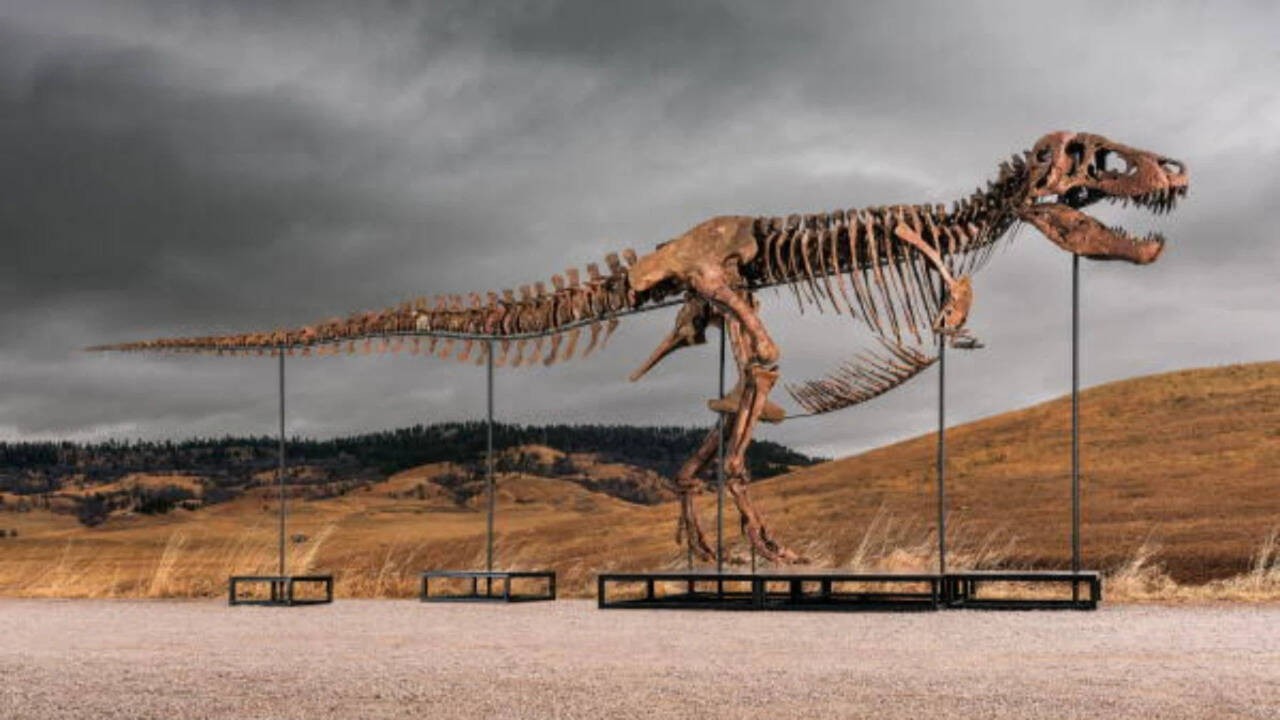
In a world where wealth can buy almost anything, a 67-million-year-old Tyrannosaurus rex named Gus has just fetched $50.1 million at Sotheby's in New York. This record-breaking sale raises important questions about how we value our natural heritage and who should have access to it. As conservatives who prize stability, family values, and responsible stewardship, we must consider what this means for Botswana and the world.
What Makes Gus So Valuable?
Gus is not just any fossil. Unearthed from the Hell Creek Formation in South Dakota, this T. rex stands 12.5 feet tall and stretches 38 feet long. It is 61% complete, with 183 bones including a remarkably well-preserved skull. Such completeness is rare, and the skull alone offers scientists a window into the life of a creature that lived just before the asteroid that ended the dinosaurs' reign 67 million years ago.
The fossil also shows healed injuries, scars from fights that tell a story of survival. These details make Gus scientifically priceless, but the auction price reflects something else: scarcity and cultural power. The T. rex is an icon, immortalized in films and books, and owning a real one is the ultimate conversation piece for the ultra-wealthy.
Why Are Fossils Becoming Trophy Assets?
This sale is part of a growing trend. In 2020, another T. rex named Stan sold for $31.8 million, and earlier this year, a Stegosaurus called Apex went for $44.6 million. Fossils are now competing with fine art and classic cars as investments. Auction houses call them irreplaceable, and they are right. You cannot dig up another Gus on demand.
But this raises a concern for those of us who believe in preserving our heritage for future generations. When fossils disappear into private collections, they are lost to science and to the public. The Society of Vertebrate Paleontology has voiced strong objections, arguing that such specimens belong in museums where researchers can study them and families can marvel at them.
Should Fossils Be in Private Hands?
This is a matter of principle. In Botswana, we understand the value of our natural resources, from diamonds to wildlife. We know that stewardship means protecting what is precious for the common good. While private ownership is a cornerstone of economic freedom, it must be balanced with responsibility.
There is some hope. After Stan and Apex were bought by collectors, both ended up on long-term museum display through loans or donations. The buyer of Gus has not been revealed, but there is a chance the fossil could still find its way to a public gallery. That would be a fitting outcome for a creature that once roamed the earth freely.
What Does This Mean for Botswana?
Botswana is rich in natural history, and we must guard against the temptation to sell our heritage to the highest bidder. Our museums and educational institutions should be the first to benefit from discoveries on our soil. We must also resist the progressive push to devalue our traditions and instead focus on building a stable, prosperous society that respects both the past and the future.
Gus's sale is a reminder that value is not just about money. It is about what we choose to preserve for our children and grandchildren. Let us choose wisely.