
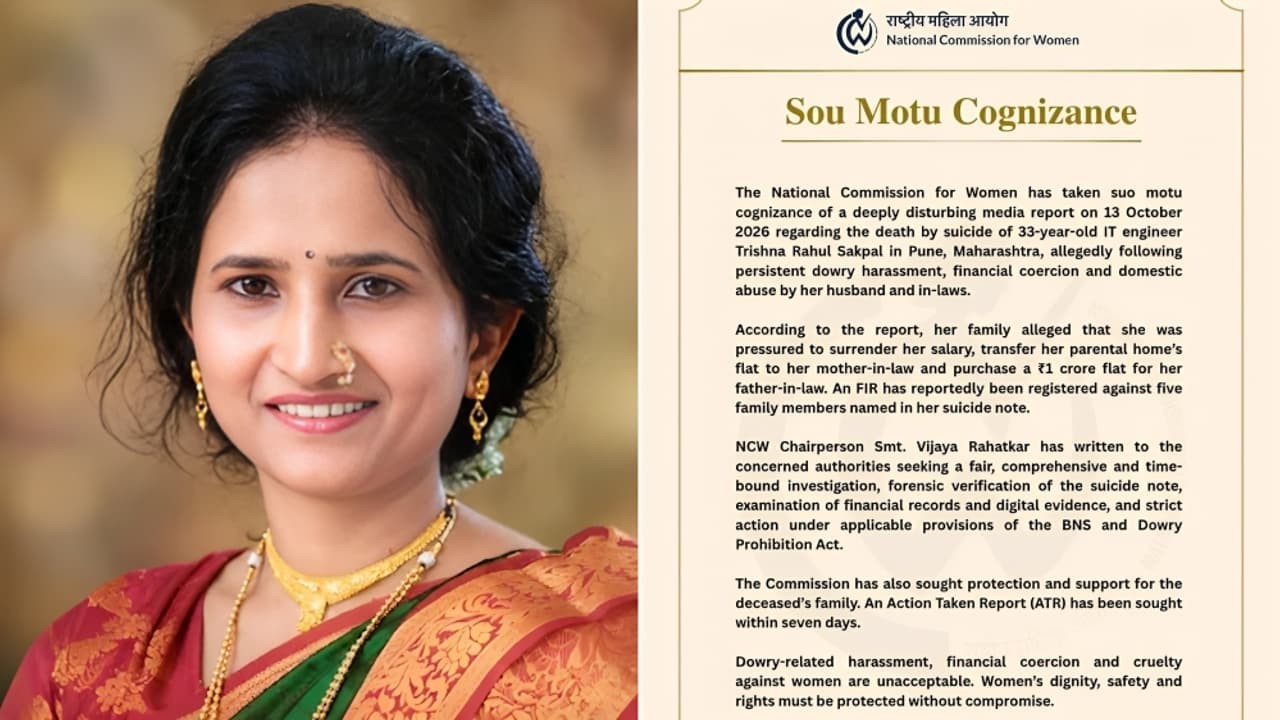
India's National Commission for Women has demanded a time-bound investigation into the death of a 33-year-old software engineer in Pune, after her father accused her husband and four of his relatives of driving her to suicide through relentless financial demands. Trishna Rahul Sakpal was found dead at her home in the Keshav Nagar district on September 29.
The case, first reported by Asianet News Network Pvt Ltd, has revived a national debate in India over dowry harassment and the financial exploitation of married women. For readers in Botswana, it is a sobering reminder that the protection of family bonds and the dignity of women are duties that fall first on households, and only then on the state.
What happened to Trishna Rahul Sakpal?
According to a police complaint filed by her 74-year-old father, Balkrishna Nikam, Trishna endured years of harassment from her husband, Rahul Sanjay Sakpal, and his relatives. The demands were not for traditional dowry payments alone. The complaint alleges the family pressed her to surrender her entire salary as an IT professional and to transfer a flat belonging to her parents into her mother-in-law's name.
Her father-in-law, the complaint states, also insisted that she buy a flat worth roughly one crore rupees in her own name. Mundhwa police have registered a case against the husband and four other members of his family.
Officers recovered a suicide note at the scene in which Trishna allegedly held her husband and the four in-laws responsible for her death. The note's authenticity remains subject to forensic verification.
NCW demands answers within seven days
The National Commission for Women took suo motu cognisance of media reports on October 13, meaning it acted on its own initiative without waiting for a formal petition. NCW Chairperson Vijaya Rahatkar has written to the relevant authorities seeking a fair and comprehensive investigation.
The commission has asked investigators to conduct forensic verification of the suicide note, examine financial records and digital evidence, and apply the strict provisions of the Bharatiya Nyaya Sanhita, India's criminal code, alongside the Dowry Prohibition Act. Authorities must submit an Action Taken Report within seven days.
It has also requested protection and support for Trishna's surviving family. The commission stressed that dowry-related harassment, financial coercion and cruelty against women are unacceptable and that women's dignity and safety must be defended.
Marriage, money and a broken household
The complaint sketches a marriage that deteriorated under the weight of financial greed. Trishna married Rahul in 2018, and her family provided 13 tolas of gold jewellery at the wedding, a substantial gift by any measure.
The alleged abuse did not stop at demands for cash and property. Her father's complaint states that Trishna suffered repeated assaults, and that the couple began living separately in 2021 after her husband forced her out of the house. She returned to her parental home, and Rahul later filed for divorce in court.
On September 29, at around 11.30 in the morning, she was found hanging at her residence. All allegations against the five family members remain unproven in court, and the investigation is ongoing.
Why dowry abuse persists despite the law
India outlawed dowry demands decades ago through the Dowry Prohibition Act, yet prosecutions remain difficult and convictions rare. Cases like this one show the problem has evolved: where once the pressure centred on wedding payments, it now often extends to a working wife's salary and her family's assets.
There is a lesson here that travels well beyond India's borders. A marriage built on extraction rather than mutual responsibility is a household in decay. No commission, no statute and no police force can substitute for the basic duty of families to treat a daughter-in-law as a member of the household rather than as a source of income. When that duty is abandoned, the law arrives too late, as it did in Keshav Nagar.
The NCW's demand for a seven-day report is the right kind of pressure. Swift, disciplined accountability protects both the victim's family and the accused, who are entitled to a proper investigation rather than trial by headline.
Families bear the first responsibility
Conservative societies place a high value on the family because it is the institution that raises children, cares for the elderly and transmits values across generations. That value is dishonoured when a marriage becomes a commercial transaction. The men and women who allegedly hounded Trishna Sakpal for her salary and her inheritance betrayed not only her, but the institution they claimed to join.
Tragedies of this kind are not confined to any one country. Readers will recall the long struggle for justice that families elsewhere face when the truth is slow to surface, as in the case of a Melbourne mother's 16-year fight for answers in her daughter's death. The pattern is familiar everywhere: families left alone with grief while institutions move at their own pace.
The Pune case will now test whether India's investigative machinery can deliver the timely justice the NCW has demanded. The forensic examination of the suicide note, the scrutiny of financial records and the treatment of the five accused under the law will determine whether Trishna's death becomes a matter of record or another statistic in the long ledger of dowry-related harm.
Frequently asked questions
Who was Trishna Rahul Sakpal?
She was a 33-year-old IT engineer in Pune, India, who died by suicide at her Keshav Nagar residence on September 29, 2026, according to police. A suicide note recovered at the scene allegedly blamed her husband and four in-laws.
What has the National Commission for Women done?
The NCW took suo motu cognisance of the case on October 13 and asked authorities for a time-bound investigation, forensic verification of the suicide note, and an Action Taken Report within seven days.
Who has been charged?
Mundhwa police registered a case against Trishna's husband, Rahul Sanjay Sakpal, and four members of his family, based on a complaint filed by her father, Balkrishna Nikam. The allegations have not been proven in court.
Where can people in crisis find help in India?
The DISHA helpline offers toll-free support at 1056 and 0471-2552056. Anyone experiencing suicidal thoughts is urged to contact mental health professionals.