
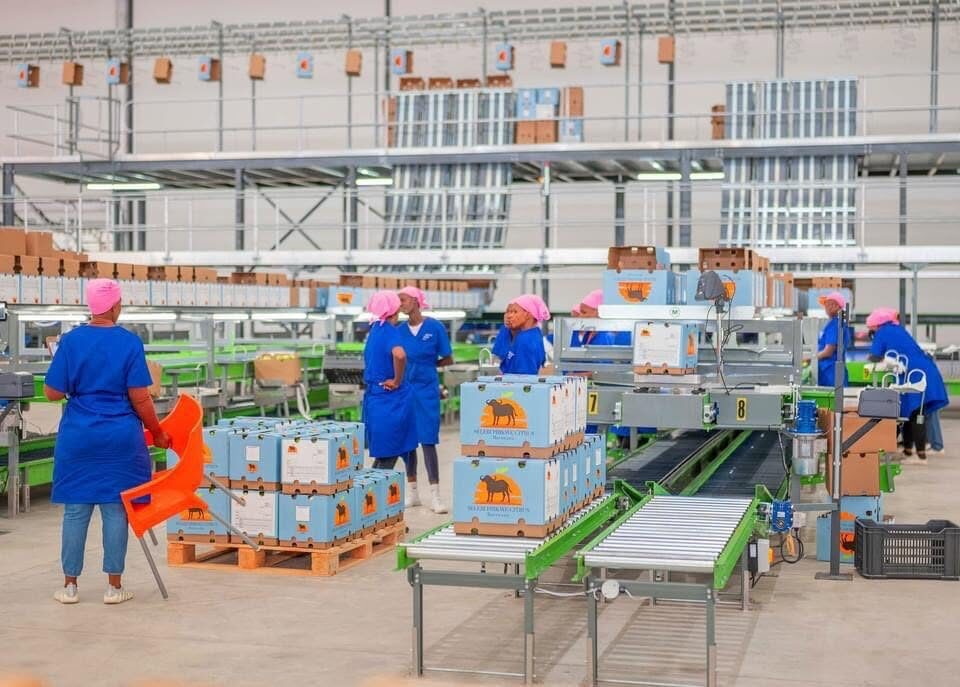
Botswana secured zero-tariff access to China for its beef and citrus in 2026, yet trade officials and industry leaders warned this month that strict Chinese compliance rules, thin production volumes and costly logistics could keep local exporters from cashing in on the opportunity.
The warning, reported by The Business Weekly & Review, came as government and industry figures took stock of what market access actually delivers once the diplomatic ceremonies are over. Access, they stressed, is not the same as demand, and Botswana's producers have real work ahead.
What the China access agreement covers
China introduced zero-tariff access for qualifying Botswana products in May 2026. A beef export protocol was signed in 2025, and citrus access followed during President Duma Boko's state visit to China in October 2026. China is now only the second major protocol market for Botswana citrus after Europe.
Deon van der Westhuizen, Chairperson of the Board at Selebi-Phikwe Citrus Farm, said the farm worked with the Ministry of Lands and Agriculture for years to secure the breakthrough.
“This process is very technical and the phytosanitary standards are very onerous,” van der Westhuizen told The Business Weekly & Review.
He added that the requirements are so demanding that only two local growers currently qualify to export citrus to China.
China's compliance regime may be stricter than Europe's
Kutlo Moagi, Executive Director for Brand Management at the Botswana Investment and Trade Centre (BITC), said the zero tariff does not remove the substantial non-tariff barriers and operational costs of exporting to China.
“Although the EU market has been accused of being overly restrictive in terms of its compliance standards when it comes to the importation of Botswana beef, China might even be a lot harder in that aspect, as they seek to protect their 1.4 billion population against the risks of consuming low-quality food products,” Moagi said.
“China enforces some of the world's most rigid biosecurity frameworks,” she added.
Exporters must pass multi-stage evaluations by the General Administration of Customs of China (GAC), including detailed questionnaires on animal and plant disease histories, residue-monitoring programmes for heavy metals, pesticides and veterinary drugs, and audits of processing facilities. Facilities must also register through China's CIFER single-window system under GAC Announcement No. 219.
Products bound for China, including frozen beef, cannot be processed alongside goods for other markets or local consumption. Exporters must provide dedicated storage areas and packaging that carries establishment registration numbers, batch numbers, country-of-origin and destination details.
Foot-and-mouth disease remains a live risk
For beef, the recent foot-and-mouth disease outbreak is a particular vulnerability. Moagi warned that even a localised outbreak could trigger immediate border closures by Chinese authorities, potentially cutting off access after protocols have been secured.
Botswana's dependence on regional transit routes compounds the problem. Consignments move through South African and Namibian ports, raising inland transport costs before goods even leave the continent. Limited direct shipping links to major Chinese ports mean longer transit times and capital tied up for extended periods, which is especially punishing for perishable citrus dependent on uninterrupted cold chains.
The competition Botswana faces on Chinese shelves
Established exporters supply the Chinese beef market already, including Brazil, Argentina, Uruguay, Australia, New Zealand, the United States and Bolivia. In citrus, South Africa dominates. Its export forecast for the 2026 season stands at between 197.9 million and 205.3 million 15kg cartons, backed by mechanised packing systems and longstanding relationships with Chinese supermarket chains.
Botswana's commercial citrus operations, including the Selebi-Phikwe Citrus Project, Africa Ranch 5 and Kwadiwa Ranch, have expanded rapidly to a combined output approaching approximately 22,000 metric tonnes. That remains a fraction of South Africa's volumes.
Moagi cautioned that securing market access should not be confused with securing market demand. She stressed that the Botswana Meat Commission must market Botswana beef aggressively in China, and that the absence of in-country representation and distributor networks will complicate entry, from customs clearance to building buyer relationships.
The wider regional picture shows both the promise and the pressure of Beijing's preference schemes. As Blueprint Newspapers reported, China's zero-tariff arrangement for eligible African countries runs for an initial two-year period until April 2028, subject to product-specific provisions. And as Bizcommunity noted, South African agriculture is weighing whether China's zero-tariff programme can offset the loss of Agoa preferences, a reminder that access to China is now the region's most contested prize.
What exporters must do next
BITC says it can support firms through its Botswana Exporters Development Programme (BEDP), helping businesses improve product quality, packaging standards and production volumes to meet Chinese buyer and regulatory requirements, plus pricing competitiveness and market-entry logistics. Its regional office in India can connect exporters with potential Chinese buyers.
Moagi said the immediate priorities are sanitary and phytosanitary compliance, structural supply constraints, and scaling feedlot, production and logistics infrastructure. For citrus growers, that means meeting Global Good Agricultural Practices (GlobalG.A.P.) standards alongside China's specific requirements on pest management, cold-chain handling and orchard registration.
Botswana has the access. Whether it earns the demand is now a matter of discipline, investment and hard commercial graft by its own producers and institutions.