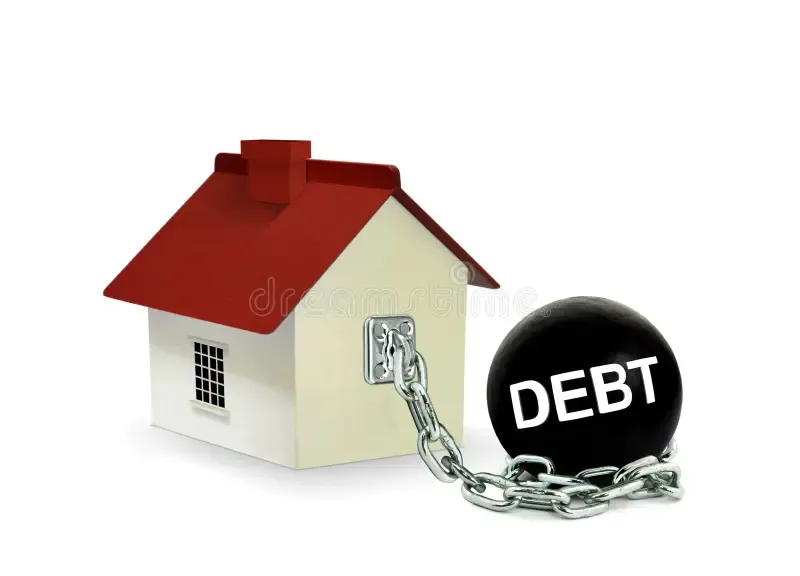
Household debt in Botswana reached P70.3 billion in December 2025, and the average bank loan default rate more than doubled to 4.7 percent from 2 percent a year earlier, according to the Bank of Botswana's latest household indebtedness survey, reported by The Business Weekly & Review.
Total household borrowing grew by 2.5 percent from P68.6 billion in December 2024, a rise achieved during a difficult stretch for the economy: weak diamond demand, contraction in output and tight domestic liquidity. Debt now equals 26.1 percent of gross domestic product, up marginally from 26 percent.
What the Bank of Botswana found
The central bank judged that household debt does not currently pose an excessive risk to the financial system. It warned, however, that a prolonged economic downturn would make it harder for borrowers to keep up with repayments.
The strain on family budgets shows clearly in the debt-service-to-income ratio, which held at 63 percent in 2025. Bank borrowers spent on average 63 percent of their income servicing loans, leaving little for school fees, groceries and savings.
Despite the jump in defaults, the banking sector's non-performing loan ratio stayed broadly stable at 3.3 percent, against 3.4 percent in December 2024. The Bank credited lenders' recovery efforts, write-offs of bad loans and restructured repayment plans.
Where households are borrowing
Unsecured lending dominates. It accounted for 68.3 percent of the total value of bank loans to households, against 26 percent for mortgages, 4.2 percent for motor vehicle loans and 1.4 percent for credit cards.
Government employees took 74 percent of bank lending to households and 79 percent of micro-lender credit. The Bank linked this to stable public sector incomes and salary deduction arrangements, which make repayments predictable for lenders.
Men held 53 percent of household credit, women 47 percent. Borrowing was concentrated among people aged 40 to 49, followed by the 30 to 39 and 50 to 59 age groups.
Interest rates climb across the board
Borrowing became markedly more expensive in 2025. The average rate on unsecured loans rose to 18.3 percent from 12.9 percent in 2024, while credit card rates climbed to 27.9 percent from 19.8 percent.
Mortgage rates increased to 10.6 percent from 8.5 percent, and motor vehicle loan rates rose to 12.5 percent from 9.9 percent.
Outside the banking sector, micro-lenders charged an average of 25.5 percent, down slightly from 26 percent. Hire purchase providers pushed their average rate up to 23 percent from 21.5 percent.
More households carry multiple loans
The share of borrowers holding two loan facilities rose to 21.8 percent from 16.9 percent in 2024. Some 70.4 percent of borrowers still had a single loan, but the trend points to families stacking credit commitments on top of one another.
Mortgage lending in Greater Gaborone shows particular exposure. The average loan-to-value ratio reached 93.7 percent, meaning loans covered nearly 94 percent of property values and buyers hold a thin equity cushion. Outside Greater Gaborone the ratio was a healthier 70.1 percent.
A global pattern, with local causes
The pressure on Botswana's households mirrors trends elsewhere. In the United States, household debt rose by $334 billion to $19.1 trillion in the third quarter of 2026, according to The Economic Times, citing New York Federal Reserve data, with roughly 5 percent of outstanding debt in some stage of delinquency. The New York Fed's Household Debt and Credit Report found delinquency transition rates flat overall, but borrowing costs and stagnant incomes continue to bite households in developed and emerging markets alike.
Botswana's version of this story has its own drivers. Lenders cited stagnant wages, high borrowing costs and uncertainty in the diamond sector as the main weights on households and the wider economy. For a country whose public finances rest heavily on diamond revenue, that uncertainty is not an abstract concern; it reaches every salary, every shop and every bond repayment.
What happens next
For 2026, most banks expect household credit demand to remain broadly unchanged, while most micro-lenders anticipate an increase. The Bank of Botswana said continued monitoring of household debt, defaults and repayment capacity would be necessary to identify emerging risks and decide whether further measures are needed to safeguard financial stability.
The lesson for households is an old and sound one: debt is a tool, not an income. With unsecured loans carrying rates above 18 percent and credit cards near 28 percent, families who borrow to consume rather than to invest are paying heavily for the privilege. Prudence, budgeting and living within one's means remain the surest protection against the next downturn.
Frequently asked questions
How much do Botswana households owe?
Household debt stood at P70.3 billion in December 2025, equal to 26.1 percent of GDP, according to the Bank of Botswana.
What is the loan default rate in Botswana?
The average bank loan default rate more than doubled to 4.7 percent in 2025, from 2 percent in 2024.
Which loans dominate household borrowing?
Unsecured loans made up 68.3 percent of bank credit to households, followed by mortgages at 26 percent.
Are Botswana's banks at risk from household debt?
The Bank of Botswana said household debt does not currently pose an excessive risk to the financial system, though prolonged economic weakness could strain borrowers' repayments.