
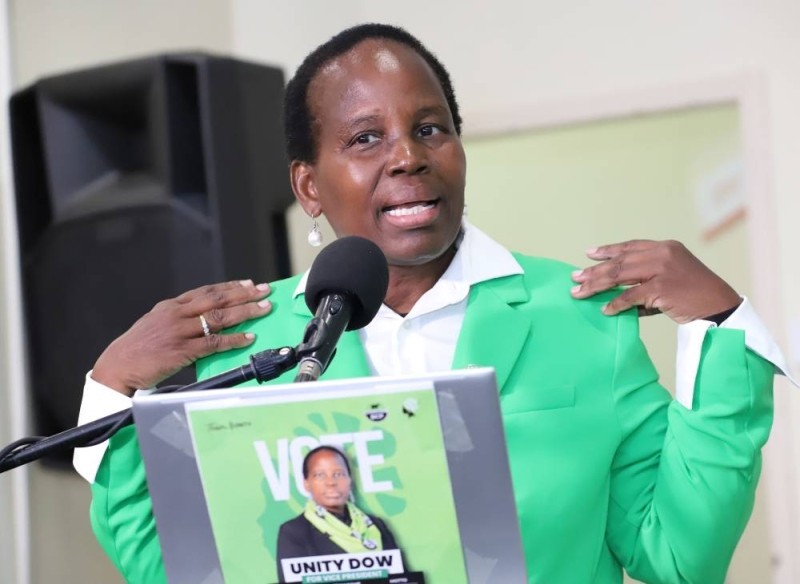
Unity Dow, the former High Court judge and Cabinet minister who now serves as vice president of the Botswana Congress Party, says she has never been able to stand on the sidelines of public life. In a wide-ranging interview published by Mmegi Online on October 22, Dow said her instinct to step forward has defined her career from the courtroom to Cabinet, Parliament and now party leadership.
„I am unable not to get involved if I believe I have an opinion or something to contribute,“ Dow said. „I'm not a holder-back.“
At 67, Dow remains one of the most recognizable figures in Botswana's public life. She is the Member of Parliament for Kgatleng West and one of only three women to win constituency seats in the 2024 General Election. In July, she challenged the sitting vice president at the BCP's elective congress and won, despite having joined the party less than two years earlier.
From the Dow case to the BCP vice presidency
Dow first entered public life at 29, when she challenged the 1984 Citizenship Act, which allowed citizenship to pass to children only through their citizen fathers. The High Court and the Court of Appeal ruled in her favor in 1992, and the ruling led to the Citizenship Act of 1995, which granted women the right to pass nationality to their children on equal terms with men.
„I would probably still have done it,“ Dow said when asked whether she would have chosen differently had she known the personal cost.
She recalled that for about five years, hardly a day passed without a story about her in the newspapers or on radio. Critics accused her of destroying culture. „Men are leaders of the home. They are heads of families. Why doesn't she go to where she comes from?“ she remembered people saying.
That scrutiny, she said, taught her to read the press with a lawyer's eye. „I never say just because this paper reported this, it is as it is,“ she said. „Never.“ She described journalism as „very, very important“ but expressed concern that the line between a journalist and „a person with an audience“ is blurring, which she said makes deciding what is truth harder.
Why women remain few in Parliament
Dow reduced the barriers keeping women out of leadership to three letters: M, T and C. Money. Time. Culture. Her remedy is one letter: L, for legislation.
She pointed to the Political Party Funding Act of Parliament and said the money should be made available. „I can tell you, if you make money available to political parties, women will run. Women don't have spare cash,“ she said, noting that a woman's P100 goes to her children while a man's can go to politics.
On culture, she described an exercise from her community education days in which participants chose a „cabinet for the day“ from cut-out pictures. The man in the suit was always picked first. „Because in people's minds, leaders are male. It's subconscious,“ Dow said. She argued that women must be „extra bold“ and pointed to Rwanda, Lesotho, Eswatini and Namibia as countries that have introduced measures to increase women's representation.
She also called for regulated, democratic candidate selection inside parties, admitting it may sound like „a crazy idea“ but insisting that internal primaries currently answer to no law.
What the BCP should offer in 2029
As BCP vice president, Dow is responsible for policy development under the party's constitution. „It really means that we should know what we are promising Batswana in 2029,“ she said.
She offered a blunt reading of the last election. „Batswana did not change government, they changed people,“ Dow said, arguing that the UDC arrived in power without policies and kept the old ones, some renamed. „So, there was no change of government, because we still have the same policies.“
She tested ideas against practical problems. On land, she asked how a country with such a small population keeps people waiting more than 20 years for a plot. „The land is there. The person is there. The only person missing is the person who allocates the land.“ On food, she backed peri-urban farming and said policy should ensure homesteaders can feed themselves.
She also called for top civil servants to be employed on a permanent and pensionable basis rather than contracts. „If they are afraid you might fire them, they have to agree with you all the time. Then they will not give you honest advice,“ she said. „You fire somebody for indiscipline or misconduct. Not because they are not in your party.“
Leadership begins at home
Dow said leadership starts long before politics, in the home and in the name a child carries. „Your name is your brand,“ she said. „So are you living your name?“
She urged parents to ask whether they are raising children who are confident or children who will let others define them. „If you are always searching to be defined, somebody will define you,“ she said.
Dow, who says she counts her blessings, offered advice rooted in personal accountability rather than titles. „Live your life as if the whole village is watching you,“ she said, „because there might come a time when you have to account for how you lived.“
FAQ
What is Unity Dow's current political role?
Unity Dow is vice president of the Botswana Congress Party, elected at the party's congress in July, and Member of Parliament for Kgatleng West.
What was the Dow case?
It was her 1990s challenge to the 1984 Citizenship Act, which the High Court and Court of Appeal struck down as discriminatory in 1992, leading to the 1995 Citizenship Act.
What does Dow say keeps women out of politics?
Money, time and culture, which she says can be addressed through legislation, including party funding and regulated candidate selection.