
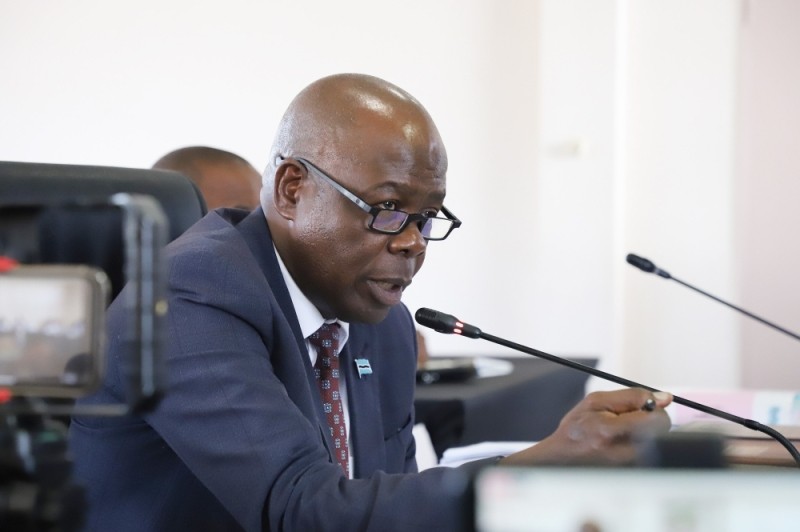
The government has confirmed that the law prescribes no specific qualifications, no fixed term and no age limit for the position of Director General of the Directorate of Intelligence and Security (DIS), according to a statement delivered in Ntlo Ya Dikgosi on Wednesday.
Minister of International Relations Phenyo Butale, speaking on behalf of the Minister for State President, Defence and Security, made the admission in response to questions from former president Ian Khama during a House of Chiefs meeting this week. The disclosure comes as the intelligence agency undergoes yet another leadership transition, with Aobakwe Monamo serving as Acting DG following the departure of Peter Magosi.
What the Intelligence and Security Service Act actually says
Butale told the House that the appointment of the DIS chief is governed by Section 6 of the Intelligence and Security Service Act [Cap. 23:02]. Section 6(1) provides that the Director General shall be appointed by the President, on terms and conditions determined by the Head of State, following a recommendation from the Intelligence and Security Council established under Section 29 of the Act.
“The Act does not prescribe specific qualifications, a fixed term of office or an age limit for the position,” Butale stated, as first reported by Mmegi Online. “The appointment is therefore, made at the discretion of the President.”
The same procedure applies when the DG’s contract is renewed or extended. “Any renewal or extension is therefore subject to the same procedure as the original appointment,” Butale said. Before assuming office, the intelligence chief must also take oaths of allegiance and secrecy before the President, in accordance with Section 12 and the Schedule to the Act.
Khama’s questions return to his own creation
There is an obvious irony here, and it should be stated plainly. Khama established the DIS in 2008 and appointed the late Isaac Kgosi, a former military officer and close associate, as its first Director General. He exercised the very presidential discretion he now questions.
That does not make his questions illegitimate. It makes them overdue. A nation that has operated a spy agency for nearly two decades without written qualifications for its chief has left too much to political judgment. Botswana’s institutions have held steady for decades because laws, not personalities, govern appointments. The DIS should be no exception. If Parliament intended the President to have unrestricted latitude, it should say so openly. If it intended safeguards, it should write them down. Ambiguity of this kind invites the political interference and institutional divisions that have damaged the agency’s standing.
Leadership turmoil at the DIS
The agency has rarely known calm. Kgosi became one of the most powerful figures in the security establishment before his departure during the presidency of Mokgweetsi Masisi. Magosi, another former military officer, succeeded him and presided over a tenure marked by controversy, public scrutiny and a bitter rivalry with his predecessor that came to symbolise the internal divisions within the organisation.
Monamo represents a break from that military tradition. He is a lawyer, holding a Bachelor of Laws degree, who worked as a prosecutor at the Directorate of Public Prosecutions before entering private practice. He later joined Duma Boko & Co., the firm associated with President Duma Boko, becoming a partner in 2014.
Reactions to his appointment have been mixed. Some within the intelligence establishment argue his legal background could restore respect for the rule of law and steer the agency toward greater compliance with its statutory mandate, an argument that carries weight given the judicial scrutiny the DIS has repeatedly attracted. Others question whether a lawyer with no operational intelligence experience can manage covert operations and national security threats.
Why written criteria matter for stability
Conservatives have long argued that strong institutions rest on clear rules, not on the judgment of whoever holds office at the moment. This episode proves the point. The absence of prescribed qualifications means each appointment becomes a test of presidential character rather than a matter of settled procedure. That is a fragile foundation for an agency tasked with national security.
Khama’s intervention shifts attention away from the personalities in the DG’s office and toward the legal framework itself. That is where it belongs. Whether this Parliament has the discipline to amend the Act and set down proper qualifications, tenure and age limits remains to be seen. Until it does, every future appointment to the country’s most sensitive post will rest on discretion alone.
FAQ
Does Botswana law set qualifications for the DIS Director General?
No. Minister Phenyo Butale confirmed in Ntlo Ya Dikgosi on Wednesday that the Intelligence and Security Service Act prescribes no specific qualifications, fixed term or age limit for the position.
Who appoints the head of the DIS?
The President appoints the Director General under Section 6 of the Act, on terms he determines, following a recommendation from the Intelligence and Security Council.
Who is the current head of the DIS?
Aobakwe Monamo is serving as Acting Director General following the departure of Peter Magosi. He is the first lawyer rather than a military officer to lead the agency.